
Board Exams, Academic Pressure & ADHD
The Perfectionist Teen: Ending the Spiral of Self-Doubt and Panic Over 93% Marks
Why perfectionism isn't healthy ambition — the hidden neurobiology of conditional worth, performance anxiety, and the unconditional regard script that breaks the meltdown.
The Report-Card Tunnel Vision
Celebrating only marks teaches that love is conditional on performance.
"Your percentage will never define your worth in this home. Mistakes are allowed here."
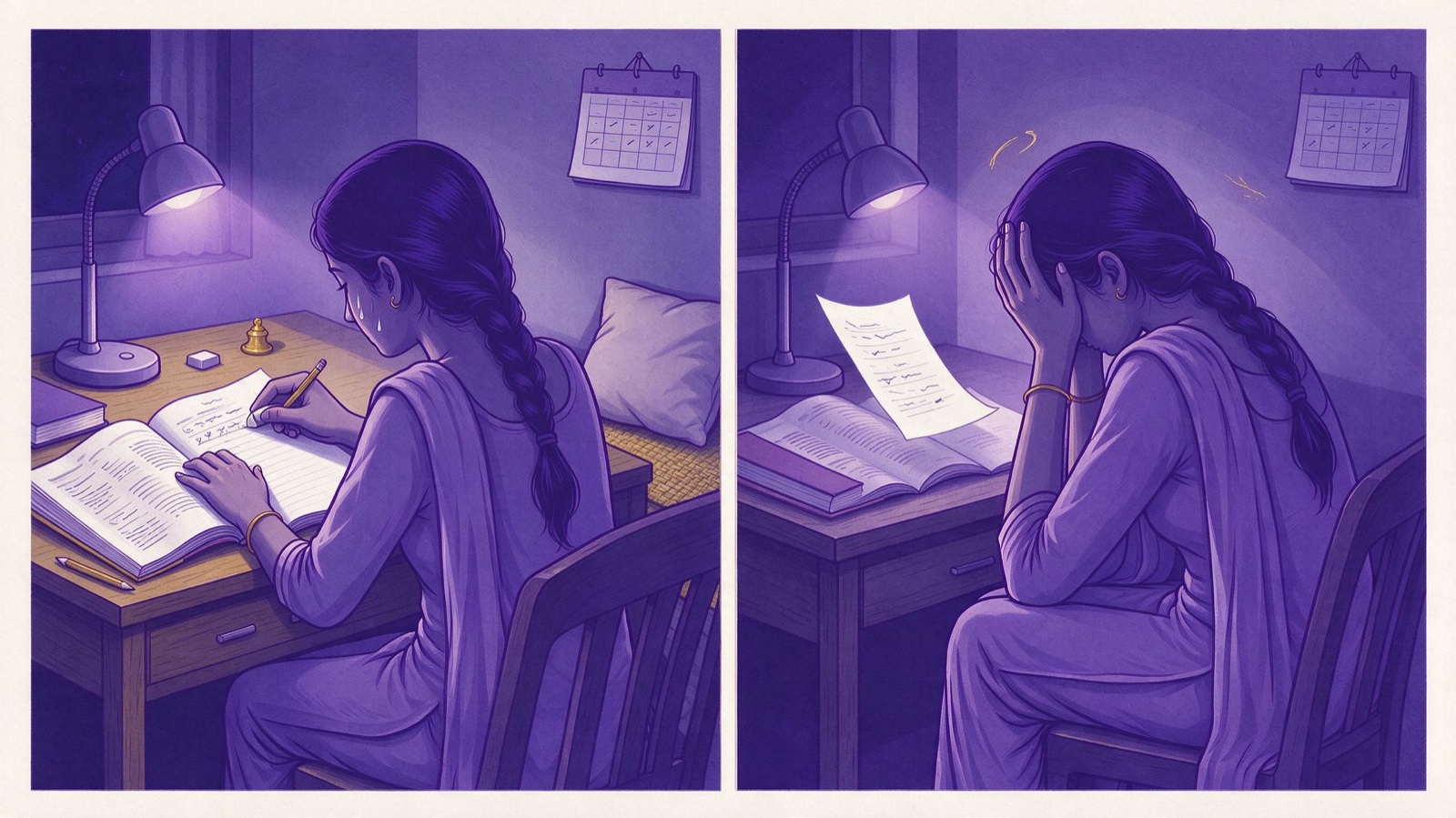
"The test results came back at 4:30 PM. She scored 94 out of 100 in advanced mathematics — an exceptional score that 95% of her batch would celebrate with ice cream."
"Instead, the door slams shut. You hear muffled sobs through the wood. When you gently knock and ask what's wrong, she screams: 'I'm so stupid! I lost six marks on the easiest calculus question! My whole term is ruined, and I won't get into any good college!'"
"You stand on the carpet completely bewildered. You try saying 'Darling, 94% is amazing! Be proud of yourself!' but your comfort only makes her angrier: 'You don't understand anything! Stop telling me it's okay when it's NOT okay!'"

Your teen is not being dramatic, ungrateful, or excessively fragile. Her developing brain has accidentally conflated flawless academic output with her fundamental right to belong and be loved. When the score drops even 2%, her nervous system experiences it as an existential threat.
What may be going on
These are possibilities to consider, not a diagnosis or certainty. Ask your teen what fits.
"I'm so stupid! My entire future is ruined because of these 6 lost marks!"
One possibility: Adolescent Catastrophic Distortion. In her limbic system, a single mistake is proof that she is an imposter who will soon be exposed and rejected.
"Stop telling me it's fine! You don't understand the cutoff ranks!"
One possibility: She is terrified that if she lowers her panic, she will become lazy and fail completely. Her perfectionism is an anxiety-fueled defense mechanism.
"I can't go to sleep yet, I still have 40 flashcards to review. (At 1:30 AM before test day)"
One possibility: Compulsive over-preparation to numb physical nausea and panic. Sleep deprivation creates an acute cortisol spiral.
The Dopamine Deficit & The All-or-Nothing Prefrontal Circuit
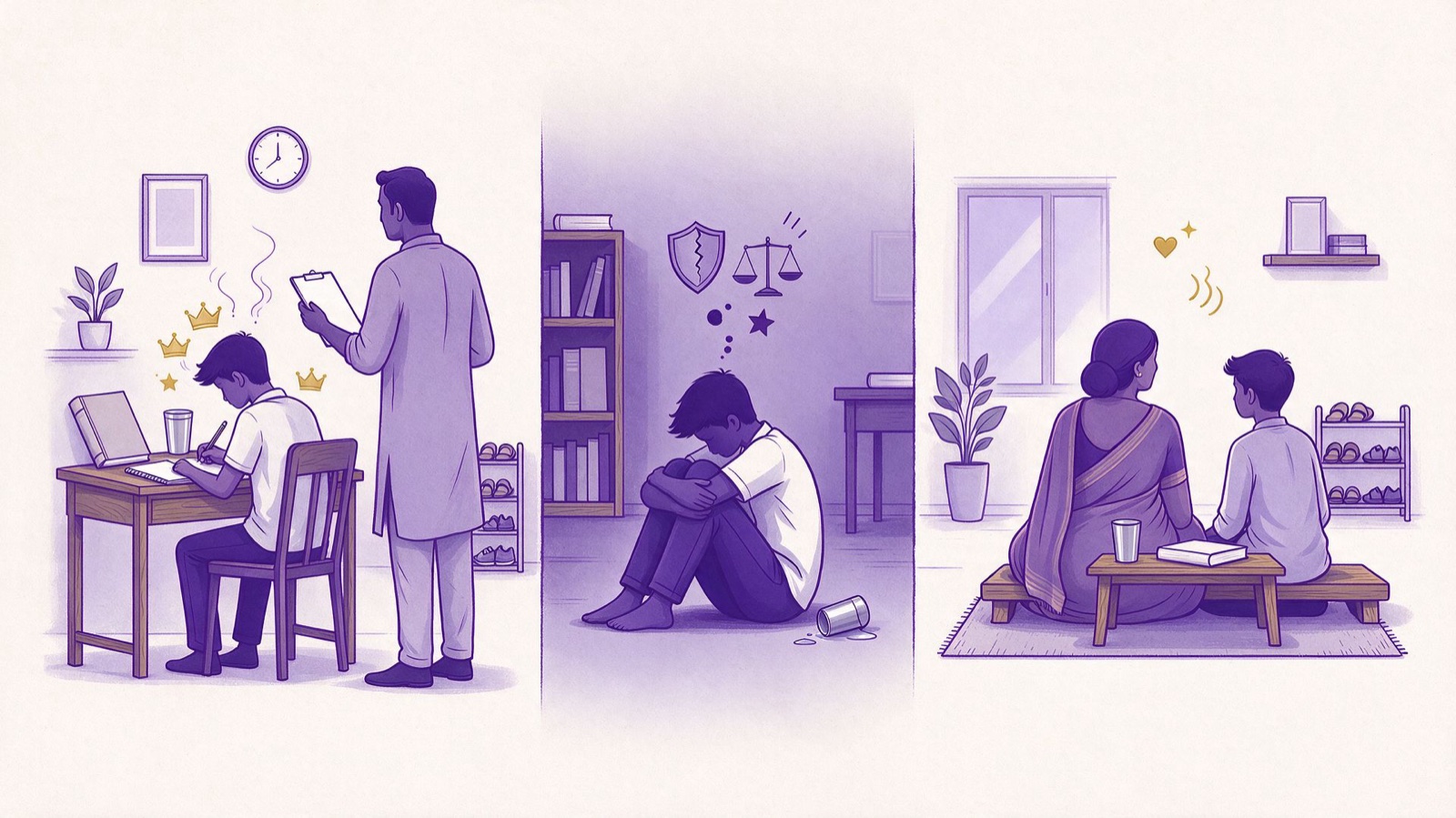
In high-achieving adolescents, perfectionism is rarely driven by high self-esteem; it is driven by intense shame avoidance. The adolescent anterior cingulate cortex (the brain's error-detection radar) becomes hyper-sensitized. When a perfectionist teen makes an error, their brain releases an acute stress surge identical to physical threat. Praise that focuses strictly on high results ('You're our star topper!') inadvertently reinforces the terrifying belief: 'My family loves me because I produce results. If I fail, I am unlovable.'
Natural Instincts That Accidentally Make It Worse
Every caring parent falls into these traps out of love, fear, or exhaustion. Here is what happens inside their nervous system and how to shift:

The Rational Dismissal ('94% is Great!')
Trying to cheer them up by quoting class averages or dismissing their disappointment.
Invalidates their emotional reality. The teen feels completely unseen and retreats into hostile isolation.
Validate the disappointment first before offering perspective: 'I hear how fiercely you cared about that question and how frustrating it feels to drop those marks.'
The Anxious Future Mirror
Parental anxiety leaking out: 'Well, did you check where the other toppers lost marks? What was the highest score?'
Instantly confirms their deepest terror: that their parents care more about comparative ranking than their emotional well-being.
Drop all peer comparisons permanently. Ask: 'How did your brain feel during the test?' instead of 'What did Rahul score?'
The 'Just Relax' Lecture
Telling an overstimulated, hyperventilating teen to 'just chill out, marks don't matter in the real world.'
Sounds hollow and hypocritical after years of schooling that emphasized exam ranks. Triggers eye-rolling and contempt.
Offer concrete physical regulation: a cold glass of water, fresh air, a warm meal, and silence.
The De-Coupling Protocol (Untangling Worth From Marks)
A 4-step clinical framework to transition a perfectionist teen from toxic performance anxiety to healthy, resilient mastery.
The Empathy Holding Period (No Logic for 60 Minutes)
Do not debate marks or offer solutions while their amygdala is flooded.
- Sit on the floor or near them with calm presence: 'I'm here. You don't have to explain anything right now.'
- Offer physical regulation: a cold drink, warm tea, or a walk outside without discussing school.
The Mistake Autopsy (Process vs. Identity)
Frame mistakes as engineering data rather than character defects.
- Once calm, ask: 'Which concept tripped you up?' instead of 'Why did you lose marks?'
- Teach the growth mindset phrase: 'You didn't fail; you discovered a gap in revision that we can fix together in 20 minutes.'
Enforce Strategic Cognitive Rest
Treat sleep and recovery as an active competitive advantage.
- Frame sleep as memory consolidation: 'Memory moves from temporary hippocampus to long-term cortex during deep sleep. Sleep is revision.'
- Establish a non-negotiable lights-out cut-off at 11:00 PM before exams.
Unconditional Regard Anchoring
Vocally reaffirm that your pride is not tied to percentages.
- Say explicitly: 'My love and pride in you does not rise or fall with a percentage on a piece of paper.'
- Notice and praise character strengths: their kindness, curiosity, sense of justice, and humor.
What to Say Tonight: Word-for-Word Scripts
Save these to your phone or keep them in mind for your next interaction.
"'I see how hard you studied and how deeply you cared about this exam. It makes complete sense that you're frustrated right now. I don't care about the six marks, but I care very much about how heavy your heart feels. Let's sit together for five minutes — no talking needed.'"
Soft, grounded, sitting on the floor or side-by-side. No rapid hand movements.
Validates the emotional intensity without validating the catastrophic conclusion. Proves parental presence is unconditional.
"'Your brain is telling you a story right now that one exam defines your entire 80-year life. That's what panic does. Take a breath with me. A test score is data about a single afternoon, not a verdict on your intelligence or your future.'"
Steady, slow, grounding eye contact.
Externalizes the panic as a temporary cognitive distortion rather than objective truth.
"'You have worked with incredible commitment today. But human memory consolidates during REM sleep, not at 1:00 AM. Going to sleep now is not quitting; it is an active part of your exam strategy. I'm turning off the desk lamp because your nervous system has earned its rest.'"
Firm, affectionate, reassuring authority.
Frames sleep as a high-performance cognitive tactic rather than a parental restriction.
Praise the effort and the person, never just the number.
Soft, grounded, sitting on the floor or side-by-side
"Your percentage will never define your worth in this home. Mistakes are allowed here."
Understanding the situation
Carol Dweck's Mindset Research & The Fragility Trap
Because their identity is anchored in effortless perfection, any difficult problem threatens their fundamental self-concept. Rather than risk looking imperfect, perfectionist adolescents will often:
Experience acute physical illness (migraines, nausea) on test mornings.
Procrastinate until the last second so they have an excuse if they fail.
Melt down over trivial mistakes because imperfection feels like public shame.
Adaptive vs. Maladaptive Perfectionism
To shift your teen from maladaptive terror to adaptive mastery, never praise their marks. Praise their process: 'I love how tenaciously you tackled that difficult thermodynamics problem' or 'I'm proud of how you took a break when your brain felt flooded.'
All Situations in Board Exams, Academic Pressure & ADHD
The Perfectionist Spiral (Crying Over 93%)
Terrified of making any mistake, chronic self-criticism, and tying their entire self-worth to report cards.
The Exam Panic & Physical Nausea Spiral
Physical sickness on test mornings, spiraling future dread, and test-taking paralysis.
Failing Grades & Academic Surrender
When marks drop, confidence collapses into 'I don't care anyway', and they give up on studying.
ADHD, Executive Lag & The Scattered Backpack
Lost books, chronic dopamine hunting, and why conventional nagging about homework never works.
Sensory Overwhelm & Social Masking Burnout
Exhaustion after school, sensory meltdowns at home, and navigating high-pressure environments.
Board Exam Season Survival (Class 10 & 12)
Three months of mock-test weather: how to be the calm parent the exam hall never provides.
You do not have to solve everything tonight
Choose one practical action that feels manageable for your family.
The 5-Minute Exam Panic Reset (Printable)
A 1-page before-test nervous-system reset to defuse exam week panic and handle report card reveals.
Talk with someone about what is happening at home
If the same conflict keeps coming back or feels difficult to manage, book a conversation to discuss the support that may fit your family.
Cross-Chapter Recommended Guides
The Unmotivated Son: Why Teenage Boys Freeze Under Academic Pressure & Retreat into Gaming
When teenage boys face mounting board exam pressure and future uncertainty, they don't ask for help—they freeze, feign apathy, and play video games for 8 hours. Understand the Future Dread driver and how to rebuild his agency.
The Silent Teen: How to Open the Door When You Only Get One-Word Answers
When your teenager retreats behind closed doors and responds in grunts, interrogating them only pushes them further away. Understand the Sensory Sanctuary driver and the exact side-by-side script that breaks the silence.
The Defiant Teen: De-escalating Explosive Arguments Without Power Struggles
When your teenager detonates over simple household requests, engaging in a screaming match guarantees defeat. Discover the Autonomy driver, the Drop-the-Rope technique, and verbatim de-escalation scripts.