
Board Exams, Academic Pressure & ADHD
Board Exam Season Survival: Being the Calm Parent the Exam Hall Never Provides
Mock-test weather for three straight months — first ise marks, then teary 2 AMs, then your own cortisol. This is the season playbook: logistics, atmosphere, and the one sentence to retire forever.
The Comparison Countdown
Every Sharma-ji mention converts their only benchmark into someone else's child.
"Signal, not sentence — we're a logistics team, not a results committee."
"The pre-board result lands on the dining table: 61% in Physics. In your head, the entire future arranges itself — college cutoffs, relatives' verdicts, that WhatsApp group."
"You say the sentence anyway: 'Is THIS what you'll get in the boards?' — and the house temperature drops ten degrees. By dinner nobody speaks. By 11 PM he's studying with tears on his notes, and you're googling 'how much do boards actually matter' at 2 AM."
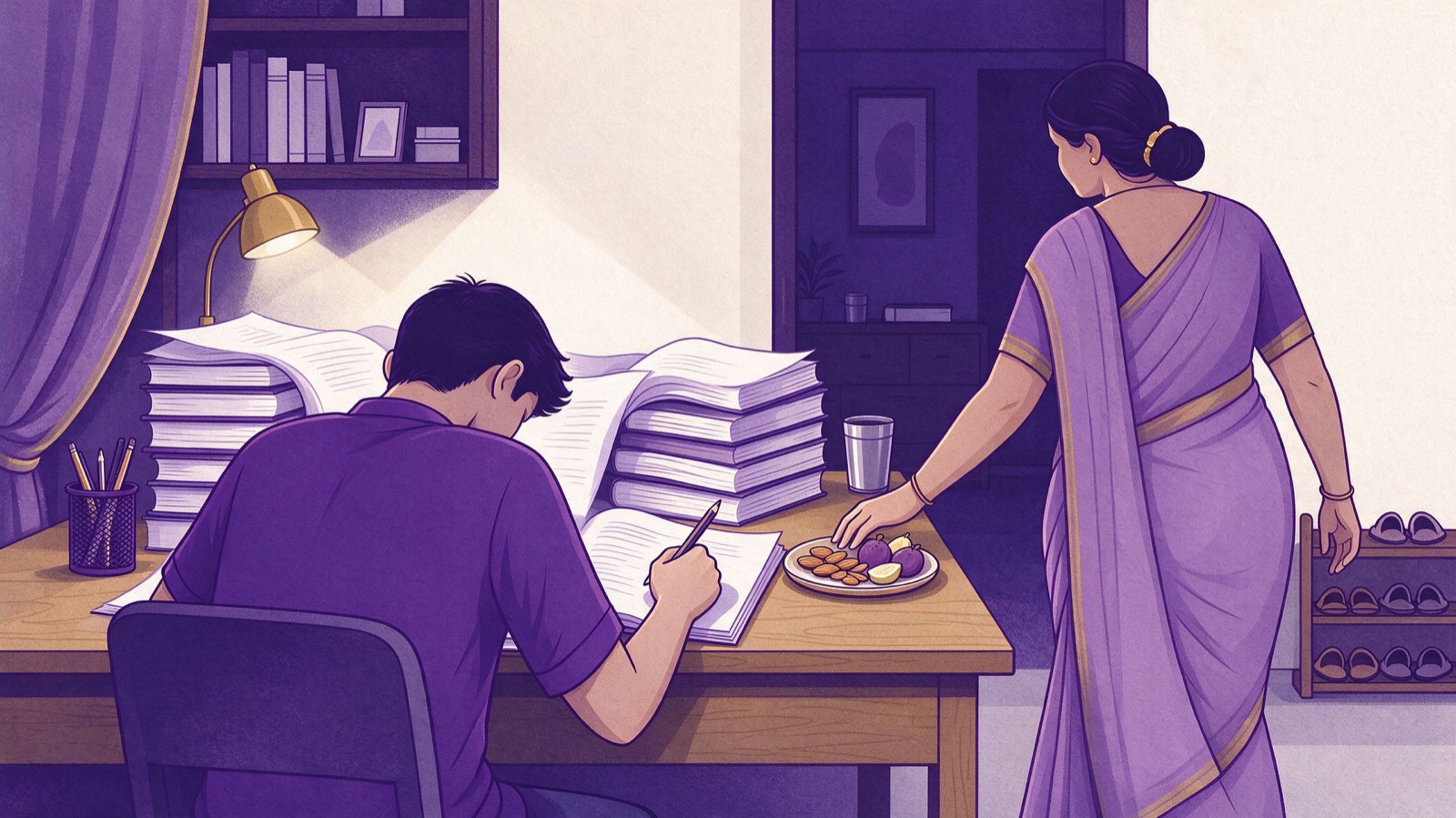
Board season punishes one thing harder than any subject: transferred anxiety. Your fear travels faster than your advice. The parent who runs logistics and atmosphere — routines, food, sleep, calm mornings — adds marks silently. The parent who conducts daily audits adds tears, secretly.
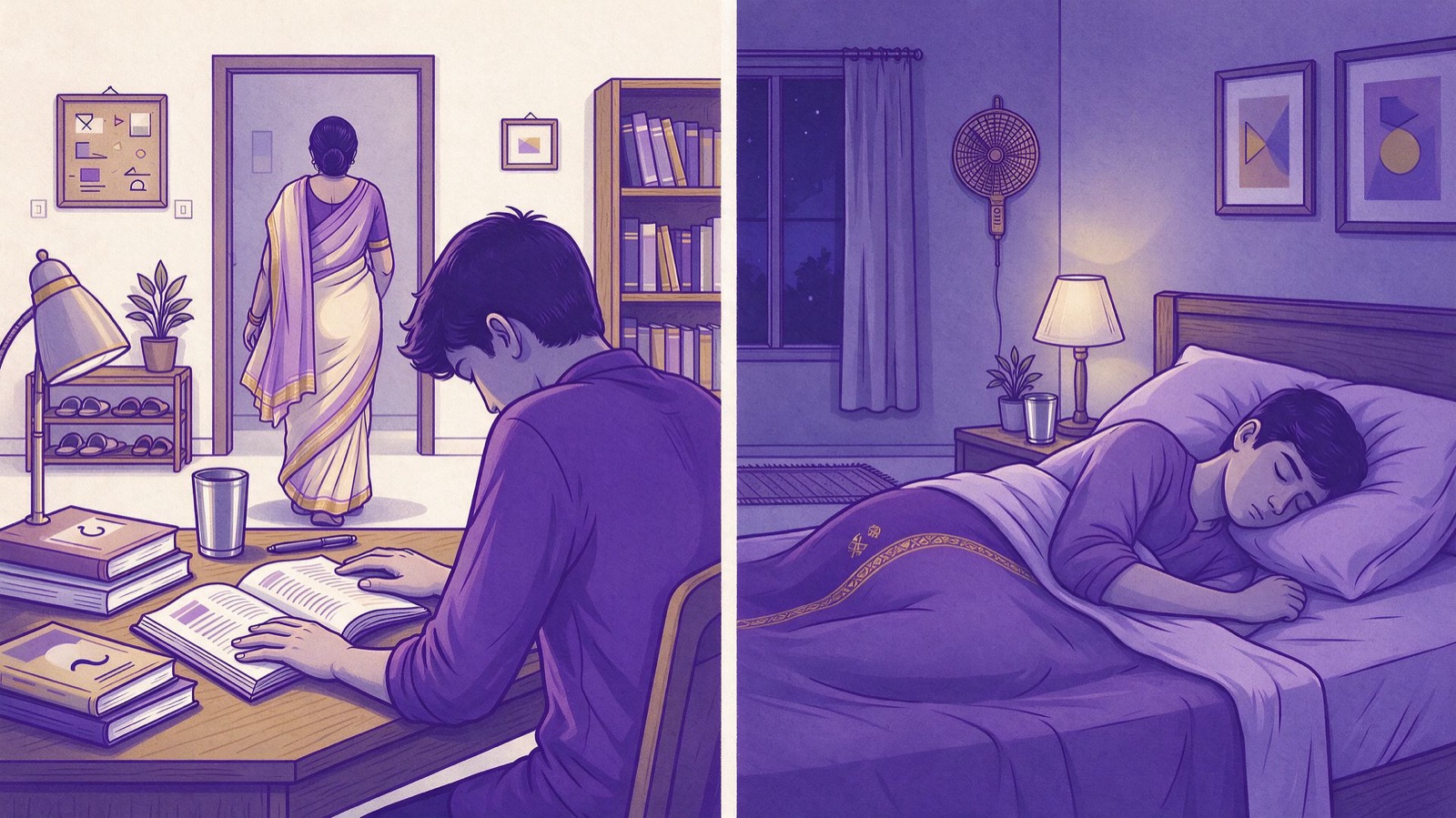
What may be going on
These are possibilities to consider, not a diagnosis or certainty. Ask your teen what fits.
"'I know, I know! Stop reminding me!' — every mention of papers acts like a slap"
One possibility: The board is the loudest event in my head already. Your repetition adds noise, not urgency. I'm drowning in the same information.
"'What if I get less than 90? College will be gone.' (2 AM door-crack confession)"
One possibility: The catastrophe loop is already running. What I need from you is a survival story, not another dismissal of my worry. Confirm I'm loved if the worst happens — THEN let me sleep.
"Sudden schedule collapse — wakes at noon, avoids the desk, marathons reels"
One possibility: The mountain has grown too steep to start. Immobility isn't laziness, it's system overload — the same freeze every anxious brain runs when stakes saturate.
Cortisol Contagion: Why Your Anxiety Is Theirs by Midnight
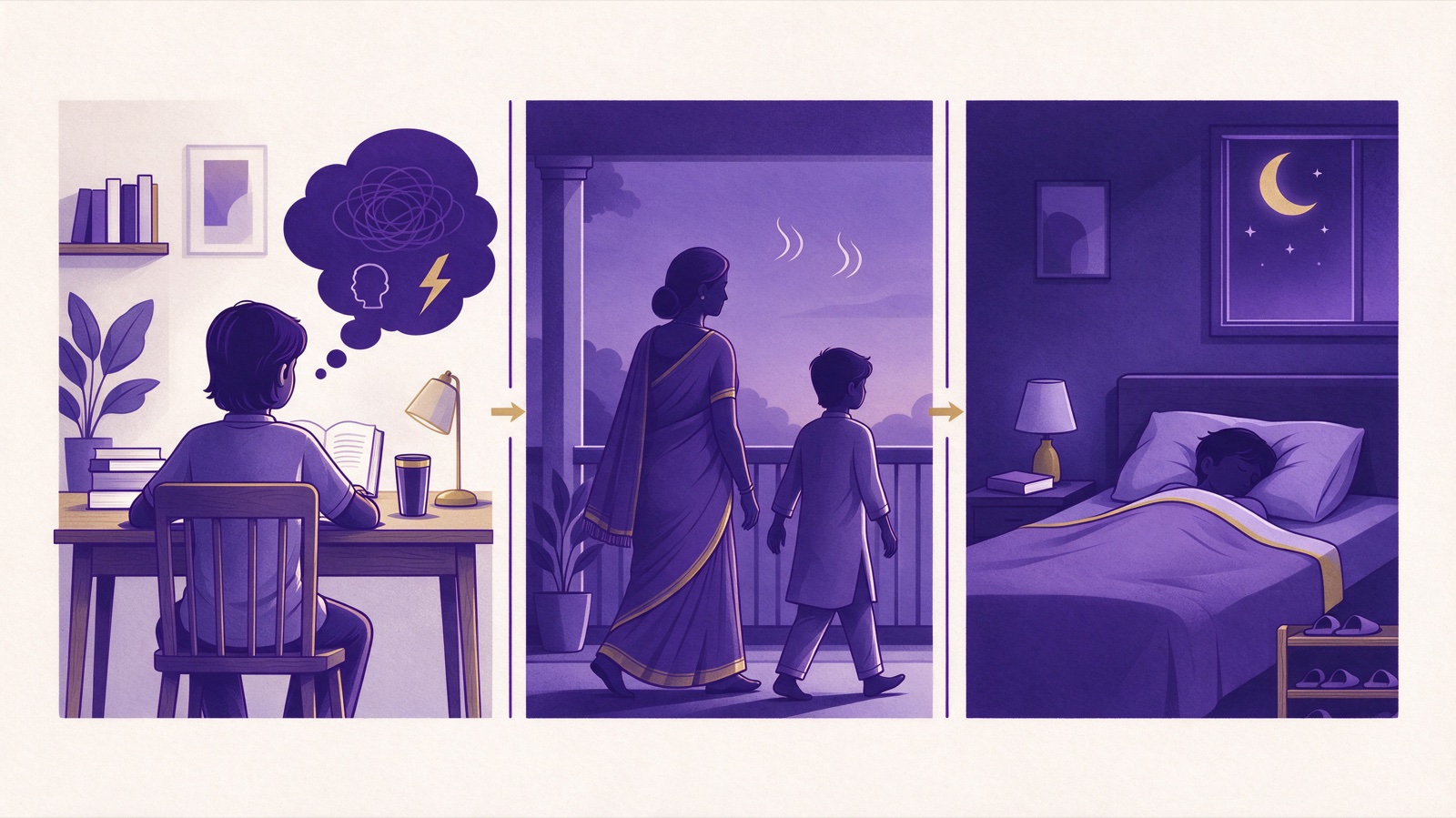
Emotional states transmit through faces, tone, and household weather faster than advice does. A parent's exam dread raises the teen's baseline cortisol within a day — measurable, peer-reviewed, and brutal in small flats where one mood fills every room. An adolescent brain under chronic exam stress learns *worse* (memory consolidation suffers under cortisol), sleeps worse, and recalls worse on exam mornings — anxiety literally hides knowledge from access. So parental calm isn't emotional charity; it's exam strategy. The compounding weapon is ritual: same meals, same wake time, same evening wind-down. Brains under threat reach for predictability — give the nervous system structure and it stops burning marks on vigilance.
Natural Instincts That Accidentally Make It Worse
Every caring parent falls into these traps out of love, fear, or exhaustion. Here is what happens inside their nervous system and how to shift:
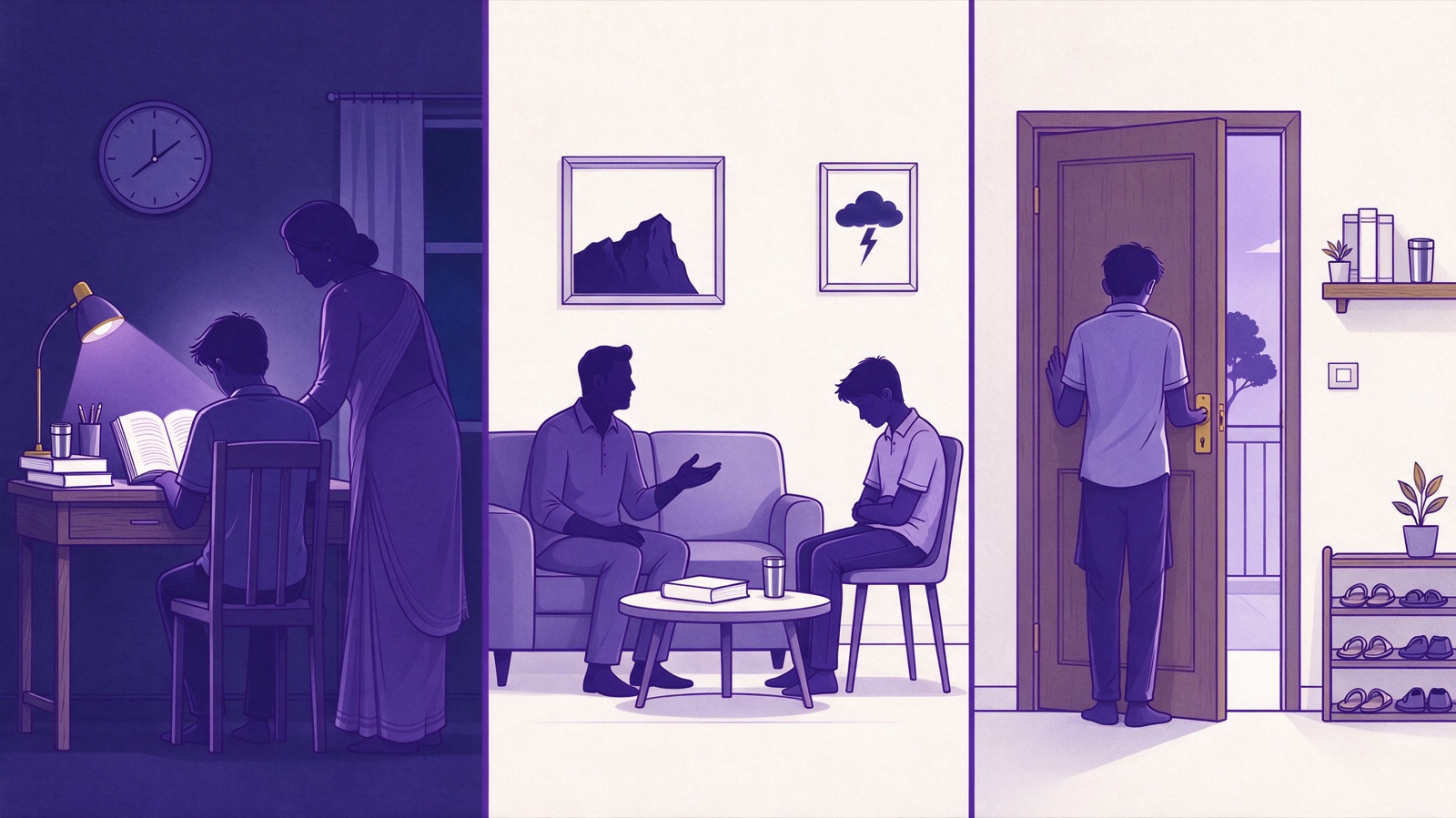
The Comparison Countdown
'Sharma ji's son wakes at 5. Your batch-mate already finished Organic.'
Converts their only benchmark into someone else's child. Shrinks your teen's worth to rank village gossip, and hands him a lifelong shame-anchor.
Contract with HIS baseline: 'Your Feb self vs your March self.' Privacy of the ladder — retire Sharma ji from the house entirely this season.
The Love-Conditional Report Tag
'We're sacrificing everything for your future' — disguised motivation, actually a debt.
Transforms exams into a family debit. Every lost mark now owes an emotional loan — teens either collapse under debt or repay with rebellion.
Unconditional platform, stated plainly: 'The sacrifice was OUR choice for our family; your only job is honest effort. Results are conversations, not bills.'
The Mock Recall Ambush
'The physics mock went badly, no? What happened in Organic also...' — audit queueng while he eats.
Turns meals into supervision. Digestion competes with dread; he starts eating faster, leaving earlier, avoiding the one safe hour left.
Insulate meals completely: no marks, no syllabus, no schedule at the table. Just stories about your own day — the only debrief is humans being humans.
The Season Protocol (Atmosphere, Rhythm, Food, Exam-Morning)
Run the season like a project manager with a heart: remove your anxiety from the air, add structure, and script the exam mornings.
Air Traffic Control (Your Own Anxiety)
Manage your flight before managing his landing.
- Write down YOUR exam fear once — fully, on paper: cutoffs, relatives, your own history. Read it, sit with it, then close the notebook. Naming drains the ambient transmission.
- Ban mark-talk at home for 48-hour stretches. One scheduled weekly check-in (Sunday, 10 minutes, pen and paper) replaces daily cortisol noise.
- Your routines matter more than his: your sleep, your tone at dinner, your face after his mock result. He reads you BEFORE he reads the paper — be the calm headline.
Rhythm Beats Cramming
A repeatable daily architecture beats heroic 14-hour sprints that collapse by week two.
- Anchor the wake time (even weekends ±1 hour); the biological clock that survived boards was trained, not heroic.
- Two 90-minute focus blocks + one 20-minute walk = a real study day.protect the walk like medicine — it empties cortisol and improves memory more than a third block.
- Night protocol fixed: devices dock 30 minutes before sleep, full 7 hours minimum. Sleep-deprived recall is the top silent marks killer.
Food, Water, Light (The ignored 30%)
Physical substrate determines memory more than the seventh revision.
- Regular meals at fixed times — no exam-day experiments, no 'studying breakfasts'. Protein at breakfast, complex carbs at dinner.
- Hydration bottle always full on the desk; dehydration masquerades as fatigue and 'brain fog'.
- Morning sunlight 10 minutes before study — genuine melatonin reset, better evening sleep, sharper afternoon recollection.
The Exam-Morning Script (Rehearse Twice)
The last hour before each paper decides whether knowledge is accessible or locked behind panic.
- Night before: bag, admit card, water — packed and photographed. Morning: no revision, only routine + breakfast + his choice of music.
- Travel with him if you can; talk about anything except the paper. If nausea hits at the gate, the 4-7-8 breath together, twice.
- After each paper: 'It's done, it's behind us. Lunch.' No post-mortems — the paper cannot change, but the next one depends on the calm he walks away with.
What to Say Tonight: Word-for-Word Scripts
Save these to your phone or keep them in mind for your next interaction.
"'61% in Physics — that's a signal, not a sentence. It tells us where to aim the next six weeks. I'm not here to conduct post-mortems; I'm here to be your logistics team. What does the paper say you needed more of — and what do WE change first?'"
Seated beside, result card face-down after one glance.
Converts a verdict into a diagnostic, makes clear the family runs as a team against the syllabus, not a parent against a child.
"'Come here. Wost-Worst case: you get less than you hoped. It changes options, not our love. Retakes exist. Other paths exist. People succeed from every rank. Tonight you sleep knowing that the family is not a results-screening committee. Water first, talk tomorrow at breakfast, in daylight where problems are manageable.'"
Seated on the sofa edge, no lecture energy, unhurried.
Provides the survival floor BEFORE sleep, making worry's tomorrow manageable, and deploys the truth that protects more than any mark ever will.
"'Your body is doing panic chemistry, not predicting the paper. Breathe with me — four seconds in, seven held, eight out. Twice. You've walked into rooms harder than this one.'"
Standing beside, eye level, hand on shoulder.
Delivers the vagal brake physically rather than arguing with it, and provides the strength-framing his memory needs to access what he knows.
Remove your anxiety from the air; the marks manage themselves upward.
Seated beside, result card face-down after one glance
"Signal, not sentence — we're a logistics team, not a results committee."
Understanding the situation
Your Anxiety Is a Household Weather System
Studies on academic stress repeatedly find the strongest single correlate of a teen's exam anxiety is parental anxiety about the same exam. Not teaching quality, not past scores, not coaching hours. The transmission is that direct. Managing YOUR state is not a nicety — it's the highest-leverage intervention available this season.
Sleep Is Marks
After the Last Paper
All Situations in Board Exams, Academic Pressure & ADHD
The Perfectionist Spiral (Crying Over 93%)
Terrified of making any mistake, chronic self-criticism, and tying their entire self-worth to report cards.
The Exam Panic & Physical Nausea Spiral
Physical sickness on test mornings, spiraling future dread, and test-taking paralysis.
Failing Grades & Academic Surrender
When marks drop, confidence collapses into 'I don't care anyway', and they give up on studying.
ADHD, Executive Lag & The Scattered Backpack
Lost books, chronic dopamine hunting, and why conventional nagging about homework never works.
Sensory Overwhelm & Social Masking Burnout
Exhaustion after school, sensory meltdowns at home, and navigating high-pressure environments.
Board Exam Season Survival (Class 10 & 12)
Three months of mock-test weather: how to be the calm parent the exam hall never provides.
You do not have to solve everything tonight
Choose one practical action that feels manageable for your family.
The 5-Minute Exam Panic Reset (Printable)
A 1-page before-test nervous-system reset — breath protocol, paper-scanning moves, exam-hall recovery drill.
Talk with someone about what is happening at home
If the same conflict keeps coming back or feels difficult to manage, book a conversation to discuss the support that may fit your family.
Cross-Chapter Recommended Guides
The Exam Panic Teen: When Test Mornings Bring Nausea and Dread
When anxiety shows up in the body — morning nausea, headaches, blanking in the exam hall — your teen isn't faking illness. Understand the alarm circuit and give them a regulation protocol that works in minutes.
The Perfectionist Teen: Ending the Spiral of Self-Doubt and Panic Over 93% Marks
When 93% feels like a failure and a minor mistake brings tears of devastation, your teen isn't being ungrateful — they are trapped in a fragile self-worth loop. Learn how to decouple their dignity from test marks.