
Board Exams, Academic Pressure & ADHD
The Surrendered Student: When Failing Grades Turn Into 'I Don't Care Anyway'
Falling marks, rolled eyes at study plans, and protective apathy — why giving up is self-defence, and the rope-ladder protocol that rebuilds effort from a rung they can reach.
The Full-Syllabus Siege
Empty planners and motivational speeches confirm the fight is unwinnable and deepen the shrug.
"One subject. Twenty minutes a day. The rest of the syllabus is off-duty for a month."
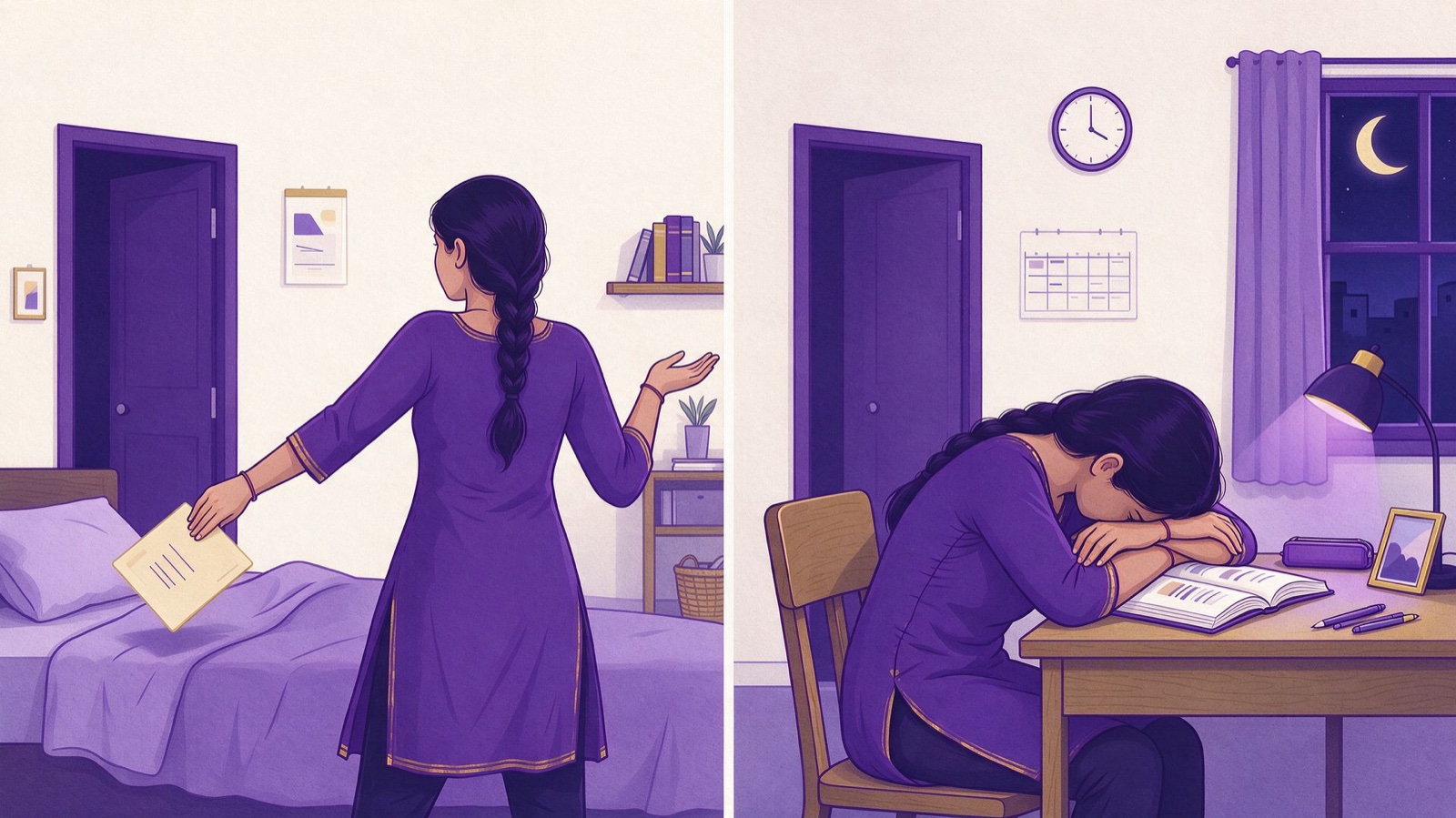
"The half-yearly report is on the dining table: three failed subjects and one more at the pass line. You have read it three times; she is watching you from the kitchen door."
"You open with the calm voice you rehearsed: 'We're not angry. We just want to understand what happened.'"
"The shrug comes first. Then: 'What's the point? I'm not made for studies. Everyone else already knows what they're doing.' By 9 PM she has watched two films on the laptop with the same blank face, and you are standing in the corridor holding the report card, wondering when exactly your child stopped trying."

Your teen hasn't become lazy — they have become defended. Behind 'I don't care anyway' is almost always a child who cared fully, failed publicly, and decided that openly trying and failing hurts more than not trying at all. Effort isn't lost; it's in protective custody.
What may be going on
These are possibilities to consider, not a diagnosis or certainty. Ask your teen what fits.
"'I don't care anyway. What's the point?' (Shoulders up, eyes down)"
One possibility: It hurts less to have chosen failure than to have wanted success and lost. 'Not caring' is the only version of tonight where I'm not publicly humiliated.
"Declines the study timetable you made — doesn't even open it"
One possibility: Your planner is written at a level I already can't reach — two subjects a night, a full chapter a day. Planning to fail at the plan itself is just a second scheduled failure.
"'Ananya got 92 without even studying much.' (Said with a sneer, not envy)"
One possibility: I've already compared myself to her a hundred times today. Everyone being ahead is proof this is unwinnable before I even start.
Protective Apathy: The Freeze Response Wearing a Shrug
When an adolescent repeatedly tries and repeatedly fails publicly, the brain's effort-reward circuitry recalibrates: trying stops paying out. The efficient adaptation is to stop predicting reward — what looks like laziness from outside is the freeze response with clever cover. 'I don't care' controls the story (I chose this) and guards dignity (I didn't lose). Meanwhile the planning prefrontal system prices every thick syllabus as unwinnable terrain and refuses the first step. Small, reachable, repeated wins — not motivation talks — are what make effort start paying again.
Natural Instincts That Accidentally Make It Worse
Every caring parent falls into these traps out of love, fear, or exhaustion. Here is what happens inside their nervous system and how to shift:

The Motivation Speech at the Report Card
Long calm lectures about future competition, board cutoffs, and 'you're brighter than you think'.
Each speech confirms the distance between the promised belief and the visible evidence of three failed subjects. They stop listening; you stop being told things.
Retire the big speech. Ask one small diagnostic: 'Which subject feels most unwinnable right now?' and build from that single subject alone.
Punishing the Surface (Screens, Outings, Phone)
Cut screen time, cut outings, add supervised study hours — reload the discipline toolkit.
Punishment cannot manufacture competence; it just makes school the enemy and files you under 'the parent who is against me'. Effort motivation drops further.
Trade supervision for structure: one 20-minute session you sit next to (not over), built around one micro-win, before any screen conversation even comes up.
The Comparison Weapon
'Look at Rahul — same school, same syllabus, and he manages both boards and 92 averages.'
Comparisons convert private shame into open shame, and shame reliably produces avoidance, not effort. It also erodes the one relationship that still tolerates your input.
Make it a race against their own last week: 'Two weeks ago you couldn't touch history. Today you finished half a chapter. That's the line we're chasing.'
The Rope-Ladder Protocol (Competence Before Confidence)
Rebuild the connection to effort rung by rung across four weeks — start with the least-hated subject, bank small wins, and only climb when the rung holds.
Declare a Cease-Fire on the Whole Syllabus
Park every big conversation — career, boards, attitude — for four weeks. Choose one subject only.
- Let them pick the subject — the least-hated one. Agency matters more than strategy at the surrender stage.
- State the contract explicitly: 'For the next month I'm not on your case about the other subjects or the hours. We do one subject, twenty minutes a day.'
- Kill the timetable. One topic per day, written on a sticky note on the study table.
The 20-Minute Micro-Win Session
Design the first step so failure isn't an option.
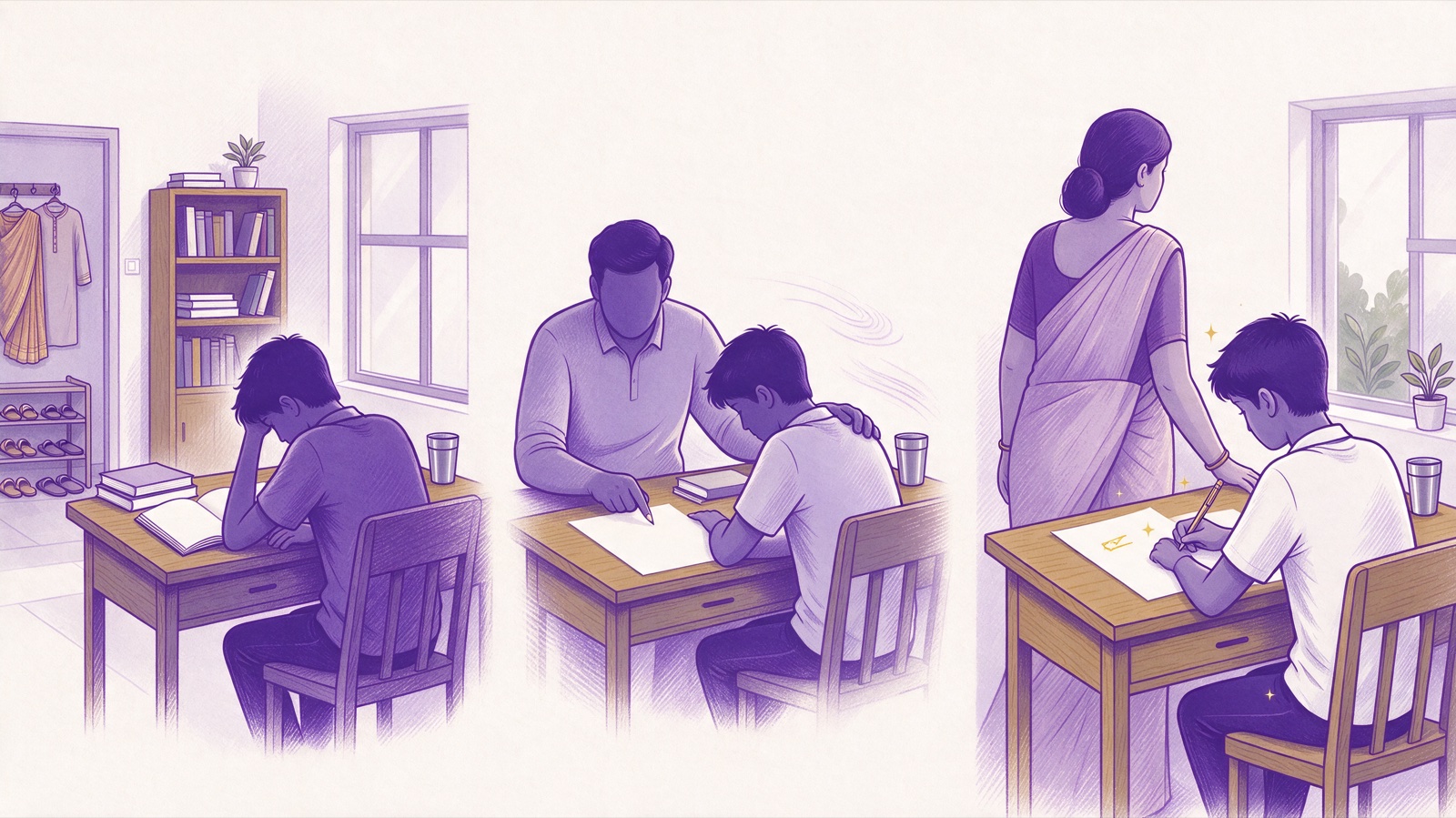
- Twenty minutes, side-by-side at the dining table (not the bedroom), with one clear finish: one exercise, one concept, one page of notes.
- Success = attempted and completed the twenty minutes, not marks accuracy. You are rebuilding the habit of turning up, not the syllabus.
- Praise the showing-up, not the output: 'You started a history page that scares you. That's the muscle we're building.'
The Visible Win Ledger
Make small progress concrete, because surrendered brains discount invisible progress.
- A simple wall chart or phone note: each completed session earns a tick. Collect the ticks — that's the point.
- End of week (15–20 ticks): a genuinely earned reward — favourite dinner, a film, an evening out. Never 'if marks improve'.
- When they say 'nothing is working', point at the chart: 'Last month, zero. This month, eighteen. Effort is paying — the ledger says so.'
Re-Enter Graded Tests (Gently)
Three or four weeks of ticks later, reintroduce small graded exposure — a chapter test at home, not a full exam.
- Frame it as their choice and their timeline: 'When you feel up to it, pick a chapter and we'll do a forty-minute practice test at home.'
- Debrief matters more than the score: what tripped them, what's next — never 'see, you could do it all along'.
- If marks start moving, resist scaling up fast. A slow climb with stable rungs beats one heroic sprint and another collapse.
What to Say Tonight: Word-for-Word Scripts
Save these to your phone or keep them in mind for your next interaction.
"'Three subjects on this report feel like a mountain, and I get why you said what's the point — it protects you from feeling worse tonight. I'm not here for the mountain. I'm here to build one single step: one subject, twenty minutes a day, nothing else for a month. Deal?'"
Report card physically put away, tea in hand, seated side-by-side.
Names the protective function of 'I don't care' without shame, shrinks the ask dramatically, and offers a contract instead of a lecture.
"'Nobody is born a studies person — brains are trained one twenty-minute block at a time, the way nobody is born fit. Prove me wrong for one month: one subject, twenty minutes a day. If by month's end you feel nothing moved, I'll drop the whole thing and we'll look at real options together.'"
Level, confident, zero desperation in the voice.
Reframes identity as a trainable skill, sets a falsifiable one-month test, and hands them the power to disprove you — agency dressed as a dare.
"'Ananya is running a different race with a different start, and comparing start lines makes me panicked too sometimes. Our race isn't her scoreboard. Our race is you-last-Monday versus you-this—Monday. That's the only scoreboard in this house.'"
Steady, affectionate, physically close — not shouted from across the room.
Cuts the comparison without dismissing the feeling, and relocates the win condition inside their own progress instead of someone else's rank.
Shrink the first rung until it can't be failed, then let wins rebuild the will.
Report card physically put away, tea in hand, seated side-by-side
"One subject. Twenty minutes a day. The rest of the syllabus is off-duty for a month."
Understanding the situation
Learned Helplessness Is a Habit, Not a Verdict
A surrendered student has usually built a private theory: my effort does not change my outcomes. And the theory has evidence — three failed subjects, years of rankings, and a home full of speeches that promised belief while delivering panic.
You cannot argue a theory like that away. You defeat it with a ledger — small wins banked so visibly that the theory has to revise itself. That is the entire logic of the Rope-Ladder Protocol: competence first, confidence second, motivation as the by-product of both.
Why the First Rung Must Be Embarrassingly Small
A rung has to be so small that declining it costs more than doing it: one exercise, one page, twenty minutes. The trick is not intensity — it is that failure becomes almost impossible at rung one. Then the reward circuitry, which still works perfectly, starts paying out again, and starting friction falls with every tick.
When Surrender Isn't About School
All Situations in Board Exams, Academic Pressure & ADHD
The Perfectionist Spiral (Crying Over 93%)
Terrified of making any mistake, chronic self-criticism, and tying their entire self-worth to report cards.
The Exam Panic & Physical Nausea Spiral
Physical sickness on test mornings, spiraling future dread, and test-taking paralysis.
Failing Grades & Academic Surrender
When marks drop, confidence collapses into 'I don't care anyway', and they give up on studying.
ADHD, Executive Lag & The Scattered Backpack
Lost books, chronic dopamine hunting, and why conventional nagging about homework never works.
Sensory Overwhelm & Social Masking Burnout
Exhaustion after school, sensory meltdowns at home, and navigating high-pressure environments.
Board Exam Season Survival (Class 10 & 12)
Three months of mock-test weather: how to be the calm parent the exam hall never provides.
You do not have to solve everything tonight
Choose one practical action that feels manageable for your family.
The 20-Minute Micro-Win Ledger (Printable)
A 1-page micro-win tracker and one-subject contract for rebuilding a surrendered student's effort habit.
Talk with someone about what is happening at home
If the same conflict keeps coming back or feels difficult to manage, book a conversation to discuss the support that may fit your family.
Cross-Chapter Recommended Guides
The Exam Panic Teen: When Test Mornings Bring Nausea and Dread
When anxiety shows up in the body — morning nausea, headaches, blanking in the exam hall — your teen isn't faking illness. Understand the alarm circuit and give them a regulation protocol that works in minutes.
The Unmotivated Son: Why Teenage Boys Freeze Under Academic Pressure & Retreat into Gaming
When teenage boys face mounting board exam pressure and future uncertainty, they don't ask for help—they freeze, feign apathy, and play video games for 8 hours. Understand the Future Dread driver and how to rebuild his agency.