
Exam Panic & Worry Reset Sheet
Break the catastrophizing spiral before mock exams and board papers.
Fill-in worksheet
Drafts stay in this browserDrafts expire after 30 days. On a shared device, use Clear when you finish.

Exam Panic & Worry Reset Sheet
Break the catastrophizing spiral before mock exams and board papers.
A practical CBT worksheet that helps students name an exam worry, check it against evidence, write a more balanced thought, and choose one next step. One line per step in your own words. Short, honest answers are easier to trust — there is no wrong answer to a personal reflection, only a true one.
Write the exact scary sentence in your head. Examples: 'I will forget everything and shame my family' or 'The paper will be too hard.'
Write one fact that supports the worry and one fact that leaves room for another outcome.
Try a calm, believable statement: 'I feel anxious right now. I can take the paper one question at a time.'
If it feels comfortable, breathe in gently and breathe out a little more slowly for three breaths. Skip this step if it feels uncomfortable or makes you dizzy.
At a Glance · Quick Protocol Summary & Key Search Answers
What Is The Exam Panic & Worry Reset Sheet?
A practical CBT worksheet that helps students name an exam worry, check it against evidence, write a more balanced thought, and choose one next step.
When anxiety spikes during evening study or the morning of a test.
- 1Name the Catastrophic Thought Exactly: Write the exact scary sentence in your head. Examples: 'I will forget everything and shame my family' or 'The paper will be too hard.'
- 2Run the Evidence Check: Write one fact that supports the worry and one fact that leaves room for another outcome.
- 3Write Your Grounded Reset Thought: Try a calm, believable statement: 'I feel anxious right now. I can take the paper one question at a time.'
- 4Optional Slow-Breathing Pause: If it feels comfortable, breathe in gently and breathe out a little more slowly for three breaths. Skip this step if it feels uncomfortable or makes you dizzy.
Overview & Purpose
A practical CBT worksheet that helps students name an exam worry, check it against evidence, write a more balanced thought, and choose one next step.
Who Can Benefit Most From This Worksheet:
- Students experiencing physical panic (racing heart, nausea) the night before tests
- Perfectionist teens who freeze upon seeing unfamiliar question formats
CBT coping skills
Writing down a worry and checking it against observable evidence can help a student respond more thoughtfully. A breathing pause or choosing a manageable question may help some students feel steadier, but neither is guaranteed to reduce anxiety or improve exam results.
Core Psychological Principles:
How to Complete This Worksheet (Step-by-Step)
Follow each step in sequence. The sequence itself is the clinical method.
Name the Catastrophic Thought Exactly
Write the exact scary sentence in your head. Examples: 'I will forget everything and shame my family' or 'The paper will be too hard.'
Run the Evidence Check
Write one fact that supports the worry and one fact that leaves room for another outcome.
Practitioner Hint: A worry can feel convincing and still be only one possibility.
Write Your Grounded Reset Thought
Try a calm, believable statement: 'I feel anxious right now. I can take the paper one question at a time.'
Optional Slow-Breathing Pause
If it feels comfortable, breathe in gently and breathe out a little more slowly for three breaths. Skip this step if it feels uncomfortable or makes you dizzy.
Practitioner Hint: Breathing slowly may help some people pause. It is fine to skip this step.
Illustrative exam-morning example
A student sees an unfamiliar question at the start of a mock exam and worries they will forget everything. This example is fictional and illustrates one way to use the worksheet.
Sample Completed Responses:
Guidance for Parents & Caregivers
How to support your teenager through this exercise without triggering defensiveness, lecturing, or power struggles.
- •Reassure the teen on exam mornings that your love and respect are unconditional, irrespective of their score.
- •Ask whether your teen wants help practising a calming pause before exam day.
- •Encourage a steady bedtime routine where possible. Avoid making one difficult night sound like it determines the exam result.
- •Do not quiz them on last-minute formulas at the breakfast table right before leaving for the test.
- •Never say 'Just don't take tension' or 'It's so easy, why are you scared?'. This invalidates their physiology.
- •Do not discuss cutoffs, entrance ranks, or future career implications on the morning of a paper.
Common Pitfalls & How to Avoid Them
Clinical Disclaimer & Emergency Mental Health Support
This worksheet is an educational instrument designed for self-reflection and coaching. It is not a substitute for clinical psychiatric care, crisis intervention, or a formal diagnostic evaluation. If you or a teenager is in acute psychological distress, connect with trained professionals:
Frequently Asked Questions
Clinical References & Scientific Citations
- Beck, J. S. (2020). Cognitive Behavior Therapy: Basics and Beyond (3rd ed.). — Guilford Publications (2020)
Is severe exam anxiety paralyzing your performance?
Explore our Study Without Struggle & Exam Calm program with Rishiraj.
Continue to Step 3: Late-Night Worry Window & Brain Dump Sheet
CBT stimulus control for teenagers caught in nocturnal rumination loops. Designed to follow this exercise to reinforce executive momentum.
Real Household Situations & Scripts for Study & Exams
The Perfectionist Teen: Ending the Spiral of Self-Doubt and Panic Over 93% Marks
Why perfectionism isn't healthy ambition — the hidden neurobiology of conditional worth, performance anxiety, and the unconditional regard script that breaks the meltdown.
The Exam Panic Teen: When Test Mornings Bring Nausea and Dread
Physical sickness before tests, blanking out in the exam hall, and spiraling 'what if I fail' dread — the panic circuit and the regulation script that resets test day.
The Surrendered Student: When Failing Grades Turn Into 'I Don't Care Anyway'
Falling marks, rolled eyes at study plans, and protective apathy — why giving up is self-defence, and the rope-ladder protocol that rebuilds effort from a rung they can reach.
Related Worksheets & Tools
Evidence-based developmental and clinical tools for students, parents, and schools.
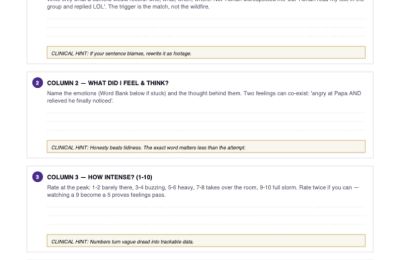
Emotion Awareness Log: Trigger → Feeling → Intensity → Response
A 4-column teen journal for catching what happened, what you felt, how big it got, and what you did.
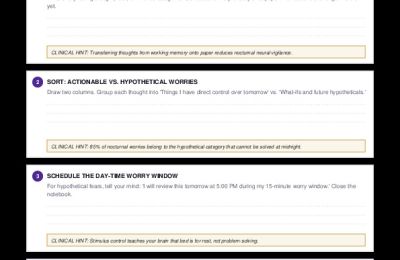
Late-Night Worry Window & Brain Dump Sheet
CBT stimulus control for teenagers caught in nocturnal rumination loops.