
Family Shifts, Gender & Sensitive Realities
The Hostel & College Transition Playbook: Sending Them Off Without Falling Apart
Packing lists are the easy part. The real job: preparing an 18-year-old for money, laundry, loneliness, and decisions no syllabus ever covered — and preparing yourself for the empty room.
The Sudden Suffocation Hover
Daily 'did you eat' texts and warden calls signal distrust — compliance outside, differentiation inside.
"You're ready — the summer was the proof. Problems are my department too, forever."
"The last bag is packed. Three suitcases, one bedding roll, and a mother on the verge of folding the same shirt for the fifth time to keep busy hands from crying."
"You rehearse the farewell speech in the car — something dignified, something warm, something that says I trust you and also don't forget to eat vegetables. What comes out instead is: 'Don't roam around at night. Call every day. Wash your clothes or you'll get sick.' All true. None sufficient."
"He hugs you once — noticeably longer than he used to — and says the sentence that will echo for weeks: 'Ma, I'll be fine.'"

You're not losing a child; you're releasing an adult whose remaining lessons can only happen off-site. The transition succeeds when both of you get homework: he learns self-management; you learn Boeing-ranked communication. The goodbye that works isn't tearless — it's prepared.
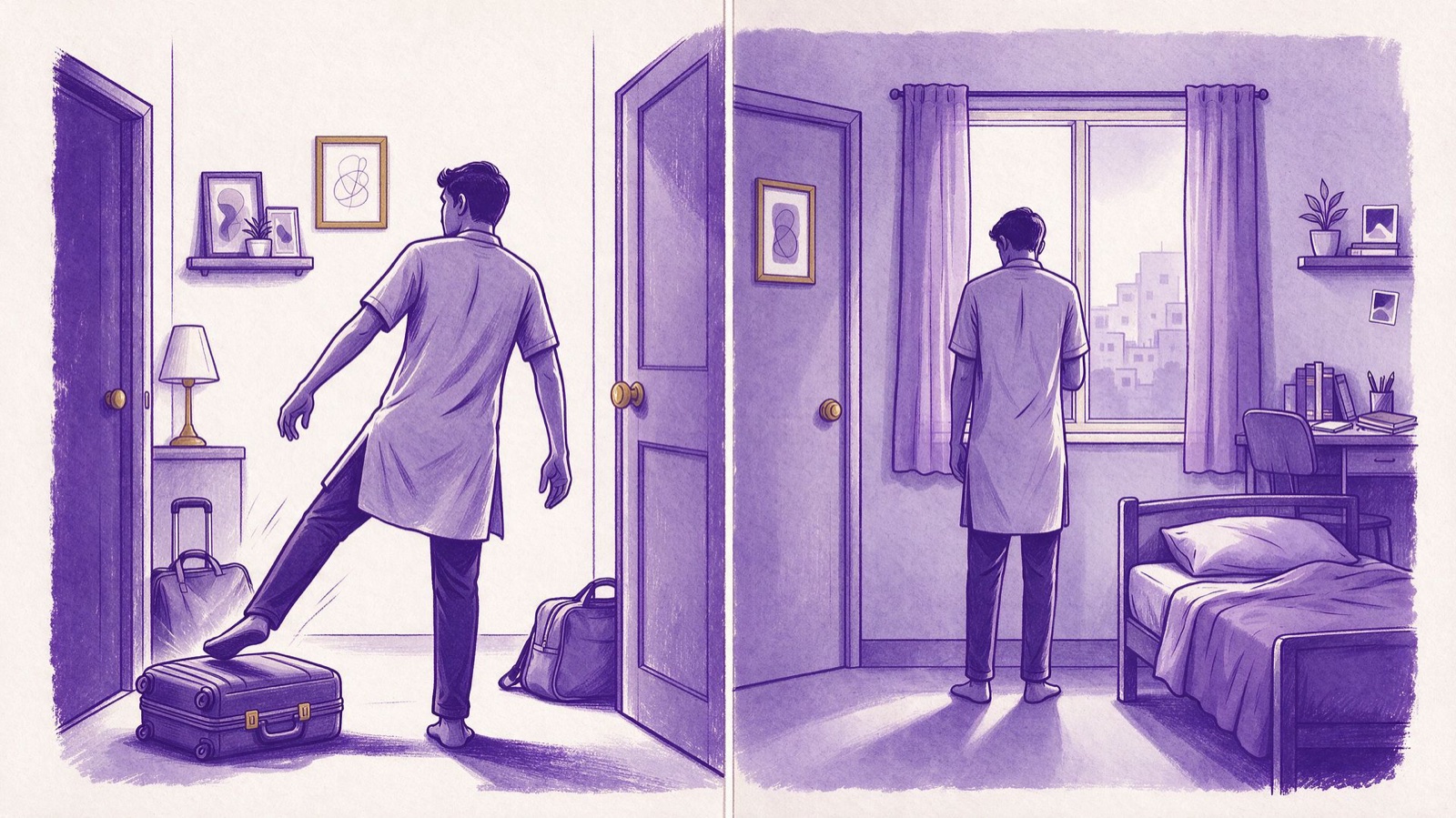
What may be going on
These are possibilities to consider, not a diagnosis or certainty. Ask your teen what fits.
"'I'll be fine, Ma. Stop worrying.' (Shortened voice, longer hug than usual)"
One possibility: I need YOU to believe it before I can. If you radiate catastrophe, I'll carry your fear into room 214 along with the bedding.
"'The mess food is fine. Everything's cool here.' (Week 2 phone call, flat delivery)"
One possibility: Homesickness hit hard but admitting it means you'll worry or implore me to come home. Reporting happiness is easier than parsing sadness.
"Sunday calls turn shorter, then skipped, then a text: 'busy with fest prep'"
One possibility: The new world is filling up — new friends, new freedoms, 19 things happening at once. The call wasn't cancelled, it was rescheduled by a calendar I don't control yet.
The Launch Window: Late Adolescence's Real Curriculum
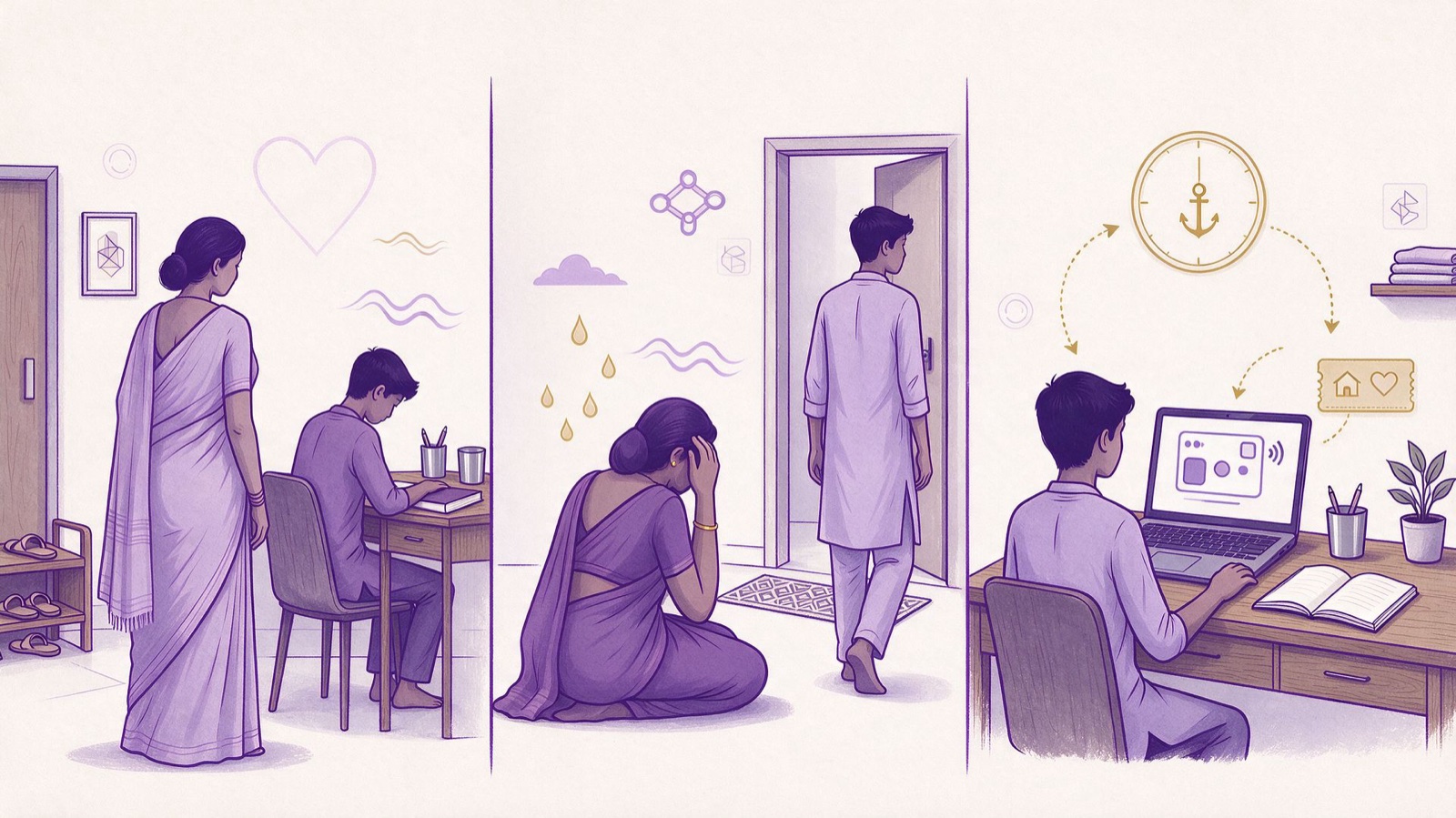
The 17–21 window is the final phase of adolescent brain development — the prefrontal cortex completes its last wiring while the person physically relocates beyond parental structure. What predicts a smooth launch isn't marks or maturity tests; it's the launch training itself: does he arrive able to manage money, food, sleep, illness, loneliness without a parent algorithm? Kids who've never owned a decision arrive to chaos; kids who've run small budgets, done own laundry, booked own tickets hit the ground functioning. The second half is parental: the empty-room grief is real — studies show it mimics bereavement patterns — and untreated it turns into 14-texts-a-day surveillance that delays the teen's own settling. The healthiest launches happen when parents grieve ON PURPOSE (planned support, new routines) rather than by accident (surprise loneliness, hover-texting).
Natural Instincts That Accidentally Make It Worse
Every caring parent falls into these traps out of love, fear, or exhaustion. Here is what happens inside their nervous system and how to shift:
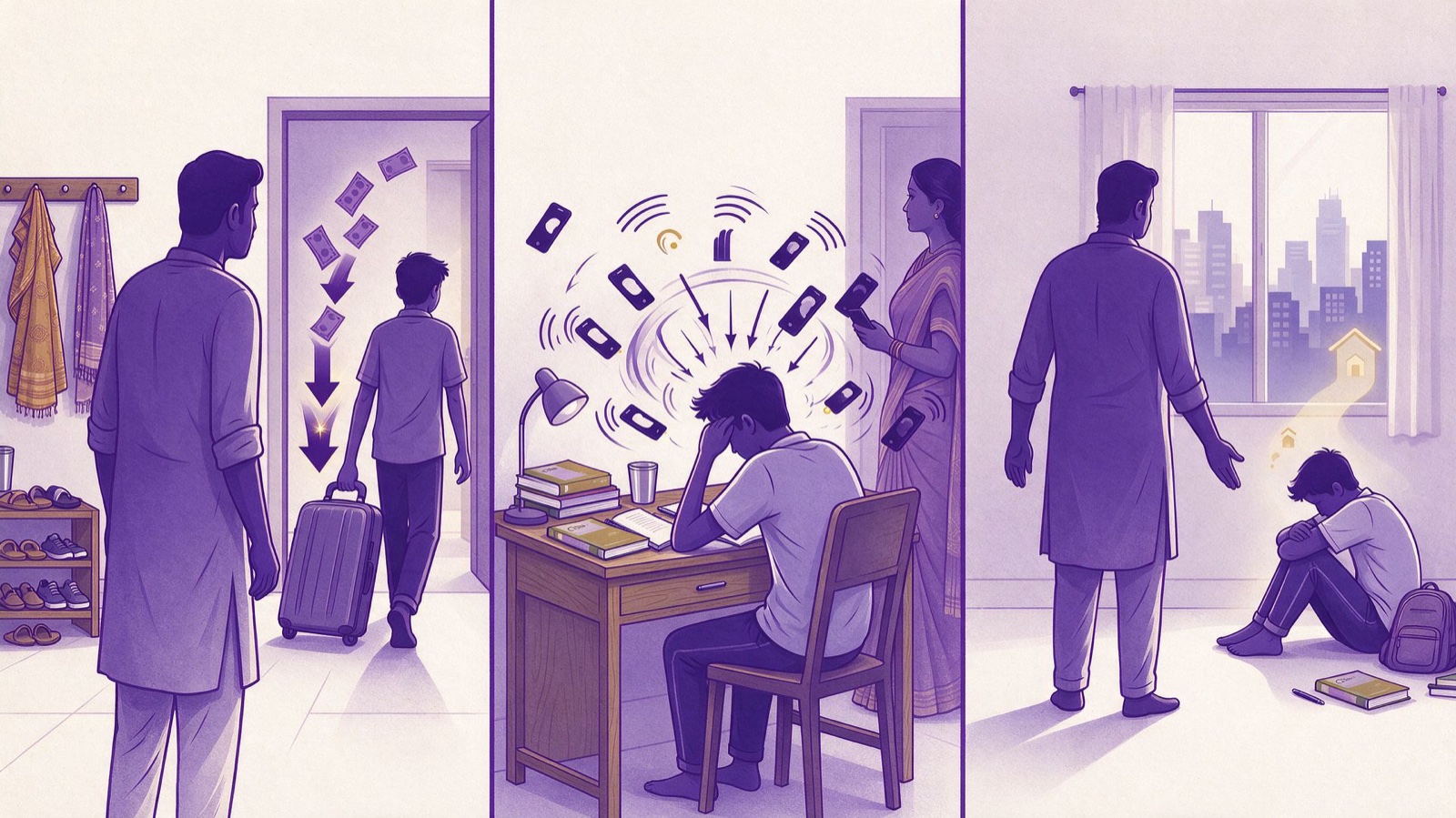
The Sudden Suffocation Hover
Daily 'did you eat' texts, location requests, calling the warden when he doesn't reply in 4 hours.
Signals the exact distrust that undermines his self-trust. He'll comply publicly (short replies) and differentiate privately (silent bitching, sheltered rule-breaking).
Scheduled contact architecture: one weekly video call + light daily texts, negotiated with him, not imposed on him.
The Money Ambiguity Bomb
'Just spend carefully beta' while transferring random amounts whenever he calls short.
No budget creativity — he either overspends (no@protocol) or under-eats (guilt). Money chaos is the most common first-semester crisis and it's fully preventable.
Structured allowance: fixed monthly transfer, agreed breakdown (food, fun, emergency), review call monthly. Money skills are life skills — teach them via practice, not panic.
The Rescue Reflex
Calling professors/wardens/relatives within a 3-hour radius every time he mentions a problem.
Trains helplessness: small problems are solved by someone else's phone-call. He'll graduate still unable to complain to a canteen manager about cold rice.
Advice-on-request protocol: 'Do you want my take, or do you want to handle it?' Escalate only on genuine red lines (health, safety, harassment).
The Launch Protocol (Train Before, Structured After)
Summer before departure = rehearsal season. First semester = structured autonomy.
Rehearse Independence (The Summer Before)
Skills unschooled before boarding become first-semester crises — run the rehearsals at home.
- Money: hand over a month's budget in one transfer — food, fun, travel, buffer — and let him misspend it once at home where mistakes are cheap.
- Life ops: one week where he handles his own laundry, doctor visit (with you driving, him talking), a bill, a booking. Real reps, real stakes, low heat.
- Emotional ops: rehearse three stories — homesickness, roommate conflict, first illness alone — 'what will you actually do?' Script the first steps together.
The Send-Off Week (Structure the Goodbye)
The final week sets the family's emotional architecture for the semester.
- One proper goodbye ritual — a family dinner, a blessing, whatever your family language is. Say the important things out loud; regret is heavier than sentiment.
- Set the contact architecture TOGETHER: weekly video call (choose the day), unlimited texts between, and one rule — 'no performance, real reports only.'
- His room-your-rules agreement: you'll keep it as a shrine OR convert it — ask him before you redecorate. Sounds tiny; it's identity.
First Semester (Structured Autonomy)
Support without surveillance for the three hardest months.
- Monthly money review on the call — 'show me what went where' — not as audit, as coaching. Adjust the breakdown as realities emerge.
- Red-line checklist, shared in advance: high fever beyond 2 days, any harassment/safety concern, signs of depression (flat for 2+ weeks), money fraud. These you escalate to; everything else he handles.
- Visit once mid-semester (pre-booked, not surprise). Come as tourist, not inspector — bring food from home, meet his friends briefly, leave warmly.
Parent-Side Transition (Your Parallel Curriculum)
Your empty-room grief needs its own plan or it leaks as hovering.
- Grieve on purpose: the first week home will feel wrong. Name it, allow it, and fill two evenings with your own things (friends, hobby, partner-dates) before you text him.
- Redefine your identity: you were full-time parent for 18 years. Post-launch parent is a new job description — advisor, harbour, at-distance coach. Write the job description down.
- Watch the marital re-entry: couples often rediscover each other post-childrens. That's an opportunity, not an obligation — plan a re-dating season if needed.
What to Say Tonight: Word-for-Word Scripts
Save these to your phone or keep them in mind for your next interaction.
"'I have one official speech, then we're done with speeches. One: you're ready — the summer you planned your money, washed your clothes, handled the doctor solo — that was you being an adult, not a rehearsal. Two: problems are my department too, forever. Any real fix short of fire — call anytime. Three: your room stays as your room until you say otherwise. That's it. I'm proud of you. Now let me cry for two minutes and then we'll watch TV.'"
Face-to-face, seated, holding hands if that's your family language. Then genuinely move to normalcy.
Bundles the three things teens need at farewell — confidence, backstop, respect for their space — while giving your own emotions a bounded, dignified slot.
"'Sounds like a heavy week. homesickness isn't weakness — it's the receipt for loving people. Here's what I know: it peaks around week 3–4 and loosens after the first festival break. Until then: one friend, one meal outside the mess, one sleep before deciding anything about coming home. Want to hear what I cooked today that you'd hate?'"
Warm, unhurried, ordinary details as the medicine.
Normalises the feeling, gives the biology a timeline (it peaks and loosens), prescribes micro-actions instead of rescue, and ends with lightness that keeps the channel open.
"'Before anything: do you want my take, or do you want to vent? Okay — venting it is. [Listen fully.] Now two questions: do you want a script for tomorrow's conversation with him, or are you handling it? Either way, I'm not calling anyone unless you say the word. You're the adult here now; I'm the consultant.'"
Consultant tone — collaborative, hands-off unless invited.
Respects his competence window, avoids the rescue reflex that disables, and produces a better outcome because he solves it — the domestic confidence builder.
Train independence before departure; run structured autonomy after; grieve your empty room on purpose.
Face-to-face, seated, holding hands if that's your family language
"You're ready — the summer was the proof. Problems are my department too, forever."
Understanding the situation
Pre-Launch Training Predicts Survival
The Empty Room Is Real
The Contact Architecture Beats Helicopter Hovering
All Situations in Family Shifts, Gender & Sensitive Realities
When Teenage Sons Push Mothers Away
Why adolescent boys pull away to assert masculine independence, and how moms connect without smothering.
When the 'Daddy's Girl' Goes Silent
Why daughters pull away from their fathers during puberty, and how dads can rebuild quiet trust.
Body Insecurities & Mirror Anxiety
Secretive eating, skipping meals, mirror obsession, and comparing real bodies to curated filters.
Secret Dating, First Crushes & Phone Secrecy
Navigating first romantic attachments, late-night texting, and heartbreak without interrogation.
Teens in Controlling Peer / Dating Relationships
Losing their identity, being manipulated by partners or friends, and helping them step away safely.
Caught in a Lie (Secret Accounts & Broken Trust)
Why teens lie to avoid humiliation or protect privacy, and how to rebuild honesty without turning into police.
Vaping, Smoking & Substance Experimentation
Finding pods, smelling smoke, peer pressure, and holding immovable health boundaries without hysteria.
Self-Harm & Overwhelming Emotional Storms
Cutting, severe emotional distress, and emergency psychological first aid for terrified parents.
Being Bullied & Excluded by Peers
Cyberbullying, exclusion from group chats, school yard cruelty, and rebuilding inner safety.
Divided Households & Co-Parenting Friction
Managing conflicting rules between two homes without putting the teenager in the middle of adult resentment.
What to Do When You Find Pornography on Their Phone
Discovered screenshots, unspeakable questions — respond with calm project-management, not catastrophe.
The Hostel & College Transition Playbook
Packing lists are easy; leaving home isn't — prepare the 18-year-old and yourself for the first real goodbye.
You do not have to solve everything tonight
Choose one practical action that feels manageable for your family.
The Launch Checklist: Money, Life-ops, Emotional Ops (Printable)
A 1-page pre-departure rehearsal sheet covering the money-transfer drill, the life-ops week, and the three emotional rehearsals.
Talk with someone about what is happening at home
If the same conflict keeps coming back or feels difficult to manage, book a conversation to discuss the support that may fit your family.
Cross-Chapter Recommended Guides
Two Homes, One Teen: Parenting Through Divorce Without Making Your Child the Messenger
Divorce ends a marriage, not a family system — but teens draft themselves as messengers, spies, and judges. The neutrality protocol: same rules both homes, zero adult content, and loyalty that never needs choosing.
The Lying Trap: Why Punishing Lies Produces Better Liars (and What Actually Works)
Lies are cost-benefit decisions made by scared brains. Lower the cost of truth below the cost of lying — the safety-to-tell protocol — and watch honesty become the rational choice again.