
The 3-Step Emotional Validation Script
De-escalate teen emotional meltdowns by validating feelings before offering solutions.
Fill-in worksheet
Drafts stay in this browserDrafts expire after 30 days. On a shared device, use Clear when you finish.

The 3-Step Emotional Validation Script
De-escalate teen emotional meltdowns by validating feelings before offering solutions.
A quick-reference guide for parents to calm an emotionally overwhelmed teen using 3 precise psychological steps. One line per step in your own words. Short, honest answers are easier to trust — there is no wrong answer to a personal reflection, only a true one.
Do not give advice, minimize the issue, or offer solutions immediately.
Say: 'It sounds like you felt really betrayed when your friend said that.'
Say: 'Anyone in your position would feel hurt after that happened.'
At a Glance · Quick Protocol Summary & Key Search Answers
What Is The The 3-Step Emotional Validation Script?
A quick-reference guide for parents to calm an emotionally overwhelmed teen using 3 precise psychological steps.
Immediately when a teen expresses intense frustration, sadness, or anger.
- 1Resist the Fix-It Urge: Do not give advice, minimize the issue, or offer solutions immediately.
- 2Name the Underlying Emotion: Say: 'It sounds like you felt really betrayed when your friend said that.'
- 3Normalize in Context: Say: 'Anyone in your position would feel hurt after that happened.'
Overview & Purpose
A quick-reference guide for parents to calm an emotionally overwhelmed teen using 3 precise psychological steps.
Who Can Benefit Most From This Worksheet:
- Parents whose attempts to comfort their teen are met with 'You don't understand!'.
Linehan's 6 Levels of Validation & Affect Labeling
When emotions run high, offering immediate logic triggers threat defenses. Accurately labeling emotions and normalizing their difficulty down-regulates amygdala activity within 60 seconds, restoring prefrontal capacity for problem-solving.
Core Psychological Principles:
How to Complete This Worksheet (Step-by-Step)
Follow each step in sequence. The sequence itself is the clinical method.
Resist the Fix-It Urge
Do not give advice, minimize the issue, or offer solutions immediately.
Name the Underlying Emotion
Say: 'It sounds like you felt really betrayed when your friend said that.'
Normalize in Context
Say: 'Anyone in your position would feel hurt after that happened.'
Supporting Priya After Peer Rejection
Priya came home crying because she was excluded from a group project.
Sample Completed Responses:
Guidance for Parents & Caregivers
How to support your teenager through this exercise without triggering defensiveness, lecturing, or power struggles.
- •Offer a physical touch (hug, hand on shoulder) if welcome.
- •Never say 'Don't cry over such small things'.
Common Pitfalls & How to Avoid Them
Clinical Disclaimer & Emergency Mental Health Support
This worksheet is an educational instrument designed for self-reflection and coaching. It is not a substitute for clinical psychiatric care, crisis intervention, or a formal diagnostic evaluation. If you or a teenager is in acute psychological distress, connect with trained professionals:
Frequently Asked Questions
Clinical References & Scientific Citations
- Linehan, M. M. (2014). DBT Skills Training Manual. — Guilford Publications (2014)
Want to transform family communication?
Explore our Communicating with Your Teen family program with Rishiraj.
Continue to Step 3: Collaborative Family Screen-Time Agreement
Co-created digital wellness rules for parents and teens without daily arguments. Designed to follow this exercise to reinforce executive momentum.
Real Household Situations & Scripts for Communication
The Silent Teen: How to Open the Door When You Only Get One-Word Answers
Why 'Fine', 'Nothing', and slammed bedroom doors aren't personal rejection — the neurobiology of adolescent shutdown and the side-by-side script that creates safety.
The Sudden Push-Away: When Your Affectionate Daughter Treats You Like the Intruder
She cringes at hugs, flinches at your questions, and guards her room like a fortress. And the worst of it, you can feel, she used to run into your arms.
Connect Before You Direct: The Golden Rule of Adolescent Cooperation
Why barking commands triggers biological resistance in the adolescent brain, and how a 2-minute connection ritual unlocks voluntary cooperation.
Mama's Boy or Mama's Wall? Navigating Closeness With Your Teenage Son
He hugs you fiercely one day and treats you like furniture the next — while his father watches from a distance he won't bridge. The real triangle, and how to stop being its referee.
Related Worksheets & Tools
Evidence-based developmental and clinical tools for students, parents, and schools.
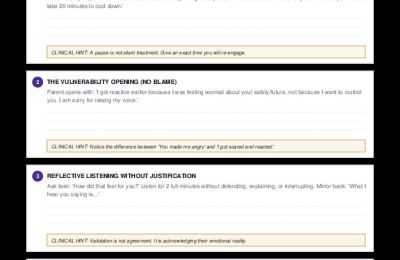
Parent-Teen Communication & Conflict Repair Script
De-escalate power struggles and repair emotional disconnect without defensiveness.
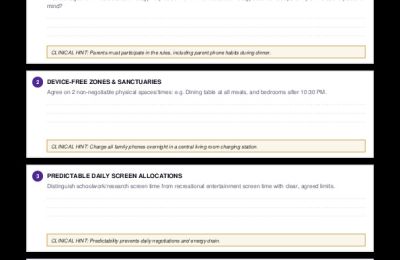
Collaborative Family Screen-Time Agreement
Co-created digital wellness rules for parents and teens without daily arguments.